Crate shipping means building a wooden or metal crate around an item and sending it as LTL freight. It is the standard answer for freight that is heavy, fragile, valuable or an awkward shape: an engine, a machine, artwork, trade-show gear, an instrument. Most pages on the topic explain how to build a crate. Very few show what a crate does to the price, so we ran the numbers: 18 live LTL quote runs and 338 carrier prices for the same freight in a crate and on a pallet, plus 8-foot and 10-foot crates, on two lanes.
The short answer
- Crate vs. pallet: when the crate and the pallet ended up in the same freight class, the crate cost about 6% to 7% more, mostly because the crate adds weight. When the crate made the shipment denser and dropped it a class (at 288 lb), it was 1% to 5% cheaper.
- Length is the big lever: an 8-foot crate drew quotes 61% to 78% above a compact crate that weighed 380 lb more. A 10-foot crate cost 81% to 99% more.
- Delivery to a home: residential delivery with a liftgate added about $159 per carrier (about 28% at the typical quote) on a 700 lb crate.
- Before you quote: weigh and measure the packed crate, not the item. Carriers price on the crate’s weight and outer size.
When to crate, and when a pallet is enough
A crate is a rigid box, usually plywood on a wood frame, that takes the knocks so the item does not. A pallet with stretch wrap, corner boards and straps holds stable, stackable goods together but gives little protection against crushing, vibration or a forklift tine. Packing guides, including FedEx’s freight packing guide for crates, point to crates for fragile, high-value, heavy or oddly shaped freight that needs extra protection.
| Your freight | Usually better in a crate | Usually fine on a pallet |
|---|---|---|
| Fragile or high value (instruments, artwork, electronics) | Yes. The crate protects against crushing and impact. | Only if it is already boxed and padded well. |
| Heavy or dense machinery (engines, gearboxes, motors) | Yes, or a heavy-duty skid with a frame. | Often fine on a pallet if bolted down and strapped. |
| Odd shapes (long, tall, overhanging parts) | Yes. A frame gives it a stable footprint. | Overhang risks damage, so a frame or crate is safer. |
| Stackable boxed goods (cartons, bins) | Rarely needed. | Yes. A pallet is cheaper and lighter. |
| International shipments | Often, with wood treated to the ISPM 15 standard. | Same wood rules apply to pallets. |
If your freight already fits a standard pallet, read our pallet shipping guide first. A crate is worth the extra cost and weight when the item cannot take a bump, which is also what carriers’ liability limits imply: LTL carriers cap what they pay for damage, usually somewhere between $1 and $25 per pound, so protection is cheaper than a claim.
Crate vs. pallet: what we quoted
To see what a crate really adds, we quoted the same freight packed two ways. For each of three items (about 290 lb, 600 lb and 1,200 lb) we built a crate by adding 3 inches of wall and padding on every side and 15% to the weight (at least 40 lb), the same rule our engine and transmission guides use. The pallet version is a standard 48 x 40 inch pallet, 6 inches taller than the item and 45 lb heavier. Each was quoted on two lanes, with the freight class set by density.
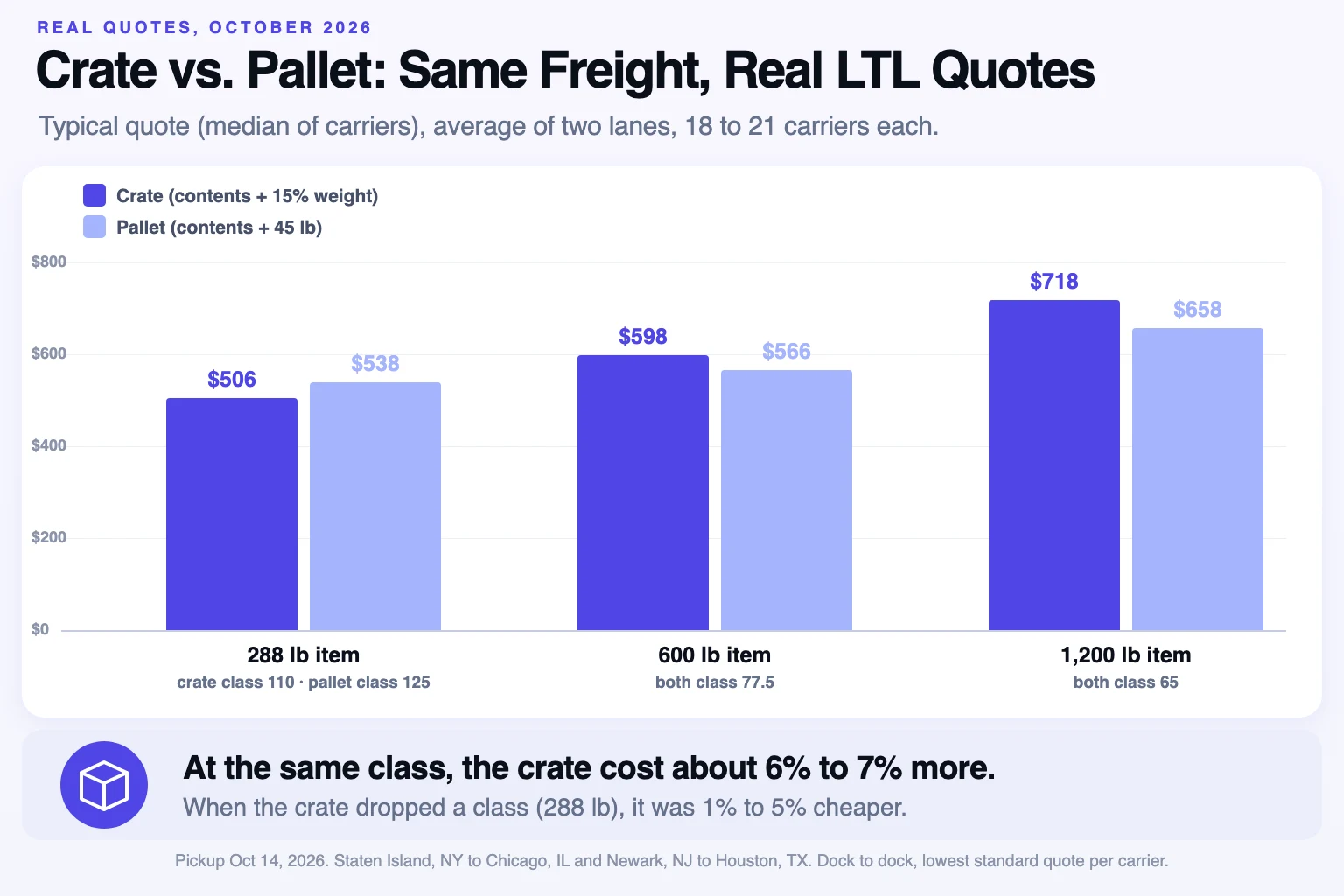
| Item and lane | Crate: size, weight, class | Pallet: size, weight, class | Typical quote: crate | Typical quote: pallet | Crate vs. pallet |
|---|---|---|---|---|---|
| 288 lb item, Staten Island to Chicago | 46 x 36 x 36 in, 288 lb, class 110 | 48 x 40 x 36 in, 295 lb, class 125 | $537 | $577 | 7% lower |
| 288 lb item, Newark to Houston | same crate | same pallet | $474 | $500 | 5% lower |
| 600 lb item, Staten Island to Chicago | 50 x 42 x 42 in, 700 lb, class 77.5 | 48 x 40 x 42 in, 645 lb, class 77.5 | $623 | $588 | 6% higher |
| 600 lb item, Newark to Houston | same crate | same pallet | $572 | $545 | 5% higher |
| 1,200 lb item, Staten Island to Chicago | 50 x 42 x 46 in, 1,380 lb, class 65 | 48 x 40 x 46 in, 1,245 lb, class 65 | $736 | $650 | 13% higher |
| 1,200 lb item, Newark to Houston | same crate | same pallet | $701 | $666 | 5% higher |
“Typical” is the median of the carriers that quoted, 17 to 21 on each run. Comparing each carrier’s own crate and pallet quote tells the same story: where the class was the same, the crate averaged about 6% to 7% more (5.6% to 7.0% across the four runs). The extra is mostly the crate’s weight, about 135 lb more than the pallet on the heaviest item.
Why the smallest crate was cheaper
The 288 lb crate had a smaller footprint than the pallet (46 x 36 inches against 48 x 40), so the packed freight was denser: 8.35 lb per cubic foot against 7.38. That moved it from class 125 to class 110. When the crate lowers the class, it can outweigh the extra crate weight. See how class changes a quote in our freight class price study.
Compare quotes for your crate
Enter the crate’s outer size and packed weight and see prices from several LTL carriers.
Get an LTL quote →How crate size and length change the price
Size matters more than the crate itself. We quoted two long crates against a compact one: a 96 x 48 x 48 inch crate (8 feet long) weighing 1,000 lb, and a 120 x 48 x 48 inch crate (10 feet) weighing 1,200 lb. Both are lighter than the 1,380 lb compact crate, but both are far less dense, which puts them in class 125 instead of class 65.
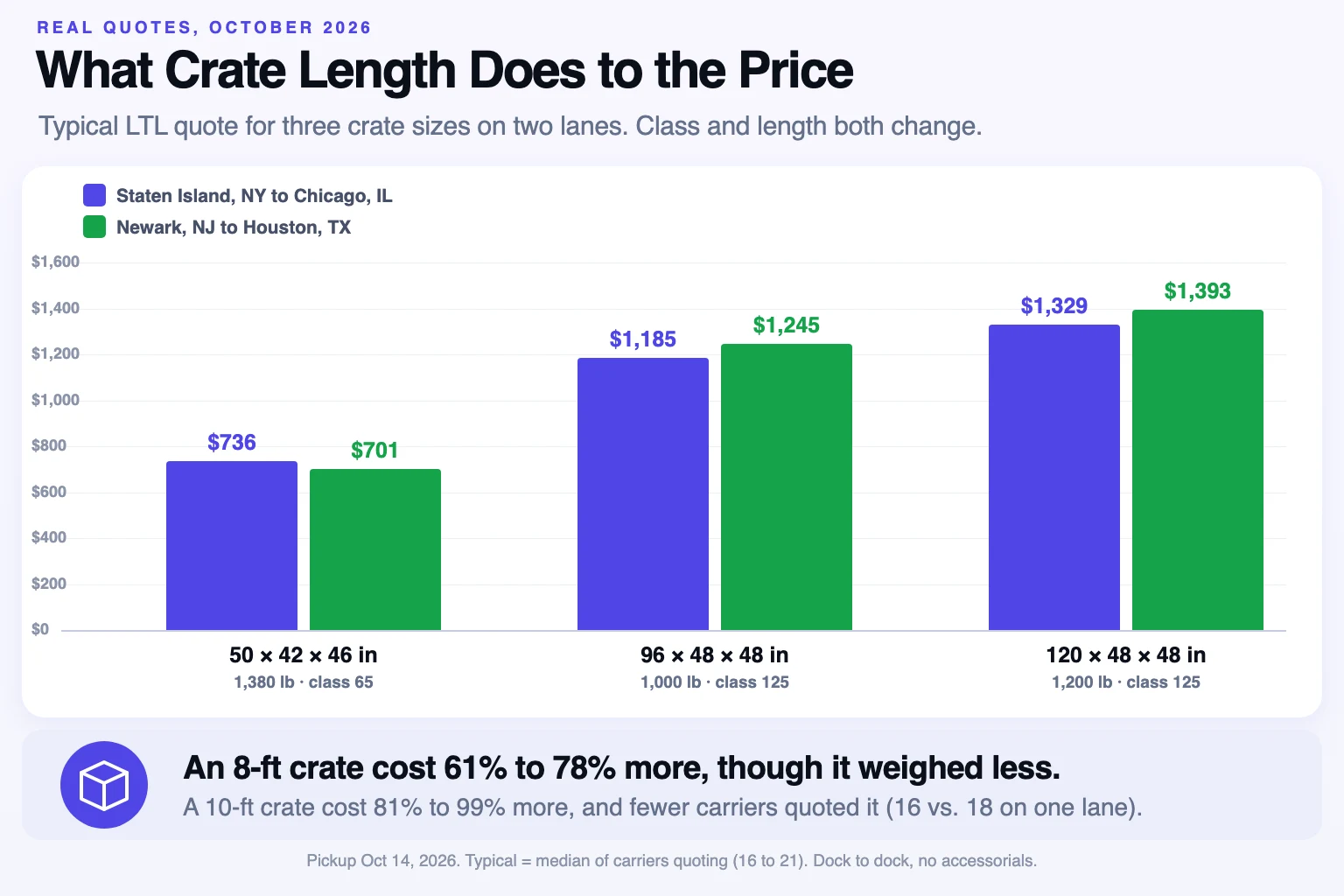
| Crate | Weight and class | Staten Island to Chicago: typical (cheapest) | Newark to Houston: typical (cheapest) |
|---|---|---|---|
| 50 x 42 x 46 in (compact) | 1,380 lb, class 65 | $736 ($442), 18 carriers | $701 ($436), 21 carriers |
| 96 x 48 x 48 in (8 ft) | 1,000 lb, class 125 | $1,185 ($568), 18 carriers; 61% above compact | $1,245 ($691), 20 carriers; 78% above compact |
| 120 x 48 x 48 in (10 ft) | 1,200 lb, class 125 | $1,329 ($807), 16 carriers; 81% above compact | $1,393 ($972), 20 carriers; 99% above compact |
Two things are working at once, and we cannot separate them in this test. Density drives the class (a bulky crate is class 125, a dense one class 65), and carriers have their own rules for long pieces: many add over-length charges at around 8 feet, and fewer carriers handle very long freight. Our 10-foot crate drew quotes from 16 carriers on one lane against 18 for the compact crate.
The cheapest quote moved too, from $442 to $807 on one lane and from $436 to $972 on the other, so shopping around does not remove the length effect. It does save more on a long crate: the typical quote sat $522 and $421 above the cheapest on the 10-foot crate, against $294 and $265 on the compact one. Learn how class pricing works in our freight class guide, and check density with the density calculator.
A crate that is only a little too long
If a crate is just over 8 feet because of padding, check whether the item can be turned or the crate shortened. Dropping below the carrier’s length threshold avoids a surcharge, and a denser crate can drop a class.
What delivery to a home adds
Crates often go to a house, a studio or a workshop. We re-quoted the 700 lb crate with residential delivery and a liftgate. Across the 17 carriers that quoted both versions (leaving out one outlier, Go2, whose price jumped by $2,745), the extra averaged $159, with a median of $167. The typical quote rose from $623 to $800, about 28%.
| Carrier | Extra for residential + liftgate | Carrier | Extra for residential + liftgate |
|---|---|---|---|
| ArcBest | $40 | TForce | $162 |
| Central Transport | $63 | STG | $167 |
| XPO | $92 | Ward | $172 |
| Estes | $99 | A. Duie Pyle | $173 |
| Forward Air | $130 | FedEx Economy | $175 |
| Pitt Ohio | $156 | FedEx Priority | $179 |
| Averitt | $216 | Old Dominion | $282 |
| R+L | $285 | Saia | $312 |
| Warp | $0 (flat rate) |
The spread is wide, from nothing to $312, so the cheapest carrier for a business-to-business delivery is not always the cheapest for a house. We cover liftgates in detail in our liftgate delivery guide and every other extra in our guide to LTL accessorial charges.
Crate planner: size, weight and class
Use the planner to turn an item’s size and weight into a crate’s outer size, packed weight, density and estimated freight class. It flags crates that reach the 8-foot mark, compares the crate with the same item on a pallet, and shows the closest real quotes from our test.
Crate planner: size, weight and freight class
Enter the item you want to crate. The planner adds crate walls and padding, estimates the packed weight, density and freight class, and shows the closest real quotes we collected.
How to crate freight for shipping
- Size the crate to the item. Leave a few inches of padding on each side. Extra empty space adds cube and weight, and our tests show both raise the price. Our planner assumes 3 inches per side.
- Use quality plywood and a solid frame. Crating guides, including FedEx’s, recommend quality lumber, ideally plywood, and caution against OSB, MDF and particleboard.
- Brace it. Diagonal braces on panels add strength, and the heaviest parts go at the bottom.
- Secure the item inside. Bolt, strap or block it so it cannot shift, and wrap loose parts. Fill empty space with padding.
- Make it forkliftable. Build the crate on skids with openings for a forklift or pallet jack, or band it to a pallet, as FedEx’s guide advises.
- Label it. Mark which end is up, mark fragile items, and attach the paperwork. Photograph the sealed crate before pickup, because the photos support a claim.
- Weigh and measure the finished crate. Use the packed weight and outer size for your quote, then work out the class with our freight class calculator. Put the same numbers on the bill of lading.
If you cannot build a crate yourself, a crating company or a packing store can build one to fit. Ask for the finished outer size and weight so you can quote accurately.
International crate shipping and wood rules
If the crate leaves the country, the wood matters as much as the freight rate. Most countries require solid wood packaging to meet the ISPM 15 standard, which is meant to stop pests travelling in crates and pallets. In the United States, the USDA’s Animal and Plant Health Inspection Service (APHIS) runs the programs that make this work. Its wood packaging page describes the main rules:
- Wood packaging is either made from lumber that was heat treated by an accredited agency, or the finished packaging is heated until the core of the wood reaches 56 degrees Celsius for at least 30 minutes.
- The producer enrolls with an inspection agency accredited by the American Lumber Standard Committee, and the treated wood carries that agency’s quality mark.
- The rules cover solid wood crates, pallets, boxes and blocking. Wood that has been manufactured into plywood or similar panels is generally treated differently, so check the exact rule for your destination.
The importing country can add its own requirements, so ask your freight forwarder or the destination country’s plant protection office before you build. Domestic LTL shipments do not need ISPM 15 treatment.
Engines, transmissions and other crated items
- Engines. A crated engine usually passes the 150 lb limit that parcel services set, so LTL is the usual choice. See how to ship an engine.
- Transmissions. Packed weight adds a base and about 15% for a crate. See how to ship a transmission.
- Auto parts. Class follows the density of the shipment as handed over, crate included. See our auto parts shipping guide.
- Shipping a crate to Hawaii. The ocean leg is priced by cubic feet, so a bulky crate costs more than a dense one. See our Hawaii LTL guide.
- Art, instruments and trade-show gear. These items often need a custom crate, a higher declared value and a delivery that includes a liftgate or inside delivery. Ask for those services when you quote.
How to lower the cost of shipping a crate
- Keep it compact. A denser crate gets a lower class, and a crate under 8 feet avoids length charges. Our 8-foot crate cost 61% to 78% more than a compact crate that weighed more.
- Do not over-build. Every inch of padding adds cube, and every pound of crate adds weight. The crate in our test added 6% to 7% to the quote at the same class.
- Compare carriers. The cheapest quote on the same crate was 20% to 50% below the typical one in our test. Flat-rate carriers can stay level when class changes, as we saw in the freight class price study.
- Choose the delivery type carefully. A business address with a dock avoids the $0 to $312 extra we saw for residential delivery with a liftgate.
- Enter the right class and weight. A wrong class or weight can lead to a reclass fee after pickup. Use our freight class calculator.
- Read the wider price data. Our study of what LTL freight costs shows how distance, weight and carrier choice move a quote.
Get quotes for your crate
Tell us the crate’s outer size, packed weight and delivery address, and compare live LTL quotes.
Get an instant LTL quote →How we ran the quotes
- Source. Live LTL quotes from the Transportli quoting platform, collected on October 12, 2026 for pickup on Wednesday, October 14, 2026. 18 quote runs and 338 carrier prices from 22 carriers.
- Lanes. Staten Island, NY (10307) to Chicago, IL (60605) and Newark, NJ (07114) to Houston, TX (77029). Both pickup and delivery were business locations with a dock or forklift, with no accessorials, except for the one residential and liftgate run.
- Shipments. Five crates (46 x 36 x 36 in at 288 lb; 50 x 42 x 42 in at 700 lb; 50 x 42 x 46 in at 1,380 lb; 96 x 48 x 48 in at 1,000 lb; 120 x 48 x 48 in at 1,200 lb) and three pallets (48 x 40 x 36 in at 295 lb; 48 x 40 x 42 in at 645 lb; 48 x 40 x 46 in at 1,245 lb), one handling unit each. Crate dimensions are the item plus 6 inches in each direction, and crate weight is the item plus 15% (at least 40 lb). Pallets add 6 inches of height and 45 lb.
- Class. The NMFC density class for each size: 110, 77.5, 65, 125 and 125 for the crates, and 125, 77.5 and 65 for the pallets. Your item may have an NMFC description that sets a different class.
- One price per carrier. We kept each carrier’s lowest standard quote and ignored guaranteed and expedited options. One carrier (AAA Cooper) returned prices tens of times higher than the rest on every run and was excluded.
- What we did not measure. The cost of building a crate, packing materials, insurance, other lanes and dates, hazardous or temperature-controlled freight, and reclassification or reweigh fees. Quotes change daily.
You can download the quote data as a CSV. Your own quote will differ with your freight, lanes and ship date, so treat this as a guide to how crates price and get a live quote for your exact crate.
Frequently asked questions
How much does it cost to ship a crate?
It depends on the crate’s weight, size, class and the lane. In our October 2026 quotes on two lanes, the typical quote for a compact crate was $474 to $537 at 288 lb, $572 to $623 at 700 lb and $701 to $736 at 1,380 lb. An 8-foot crate at 1,000 lb ran $1,185 to $1,245, and a 10-foot crate at 1,200 lb ran $1,329 to $1,393. Cheapest quotes were lower.
Is it cheaper to ship in a crate or on a pallet?
Usually the pallet is cheaper, by about 6% to 7% in our test when both landed in the same freight class, because a crate adds weight. A crate can be cheaper when it is shorter and denser than the pallet version and drops the shipment a class, as it did for our 288 lb item.
What freight class is a crate?
Class comes from the shipment’s density, which is packed weight divided by cubic feet, unless your item has its own NMFC description. Our crates ranged from class 65 for a dense 1,380 lb crate to class 125 for long, light crates. Use a density calculator with the crate’s outer size and packed weight.
How big can a crate be for LTL?
Limits vary by carrier. Many add over-length charges around 8 feet, and fewer carriers accept very long pieces. We quoted crates up to 10 feet long and got prices from 16 to 20 carriers, but a long crate can cost 60% to 100% more than a compact one.
How much weight does a crate add?
About 15% of the contents, with a 40 lb minimum, is a good planning figure for a plywood crate, and it is the rule we used. A standard pallet adds about 45 lb. Weigh the finished crate, because carriers price on the actual packed weight.
Do I need to put a crate on a pallet?
Carriers need to move the crate with a forklift or pallet jack, so it needs skids with forklift openings or a pallet under it. FedEx’s packing guidance for crates advises attaching the crate to a pallet with bands or building it with forklift openings.
How do I ship a crate overseas?
Use solid wood that meets the ISPM 15 standard (heat treated and marked by an accredited agency) or a crate made of processed wood panels, then check the destination country’s rules. USDA APHIS describes the heat treatment as heating the wood core to 56 degrees Celsius for at least 30 minutes. Domestic LTL does not need treated wood.
Can I ship a crate to a residence?
Yes. Ask for residential delivery and a liftgate when you quote. In our test on a 700 lb crate, that combination added $0 to $312 depending on the carrier, about $159 on average, and about 28% at the typical quote.