Hot shot trucking is a way of moving urgent, smaller loads with a heavy-duty pickup truck, often a one-ton dually, pulling a flatbed or gooseneck trailer. The truck picks up your freight and drives it straight to its destination, with no terminals, no transfers and no waiting for other shipments to fill the trailer.
That makes hot shot a good fit for freight that is too big or awkward for a cargo van, too urgent for standard LTL, and not worth a full tractor-trailer. This guide explains how hot shot trucking works, what equipment and freight it involves, what the CDL and USDOT rules look like, what drives the price, and how to get a quote. If you are thinking about driving hot shot instead, there is a section for you too.
The short version
- What it is: a pickup truck plus an open trailer (flatbed, gooseneck or bumper-pull) hauling time-sensitive loads directly from pickup to delivery.
- What it hauls: equipment, machinery, building materials, parts and vehicles, meaning loads that need an open deck rather than an enclosed van.
- How it differs from a Sprinter or box truck: vans and box trucks carry freight inside an enclosed body. Hot shot carries it on an open trailer.
- CDL: often not required, because many rigs stay under a combined rating of 26,001 lb. Check the ratings of your truck and trailer.
- Price: quoted per load. It depends on distance, urgency, trailer type and the size and weight of the load.
How hot shot trucking works
A hot shot move is simple by design:
- You request a quote with your pickup and delivery locations, the weight and dimensions of the load, and your deadline.
- A carrier with a matching truck and trailer is dispatched. The rig has to fit the load: the right deck length, the right weight rating, and a way to load it.
- The driver loads and secures the freight at pickup, using ramps, a forklift or crane at the shipper’s site, or drive-on loading for equipment.
- The load goes direct to the destination. There is no consolidation, so transit time comes down to distance and drive time.
- The load is delivered and unloaded at the destination.
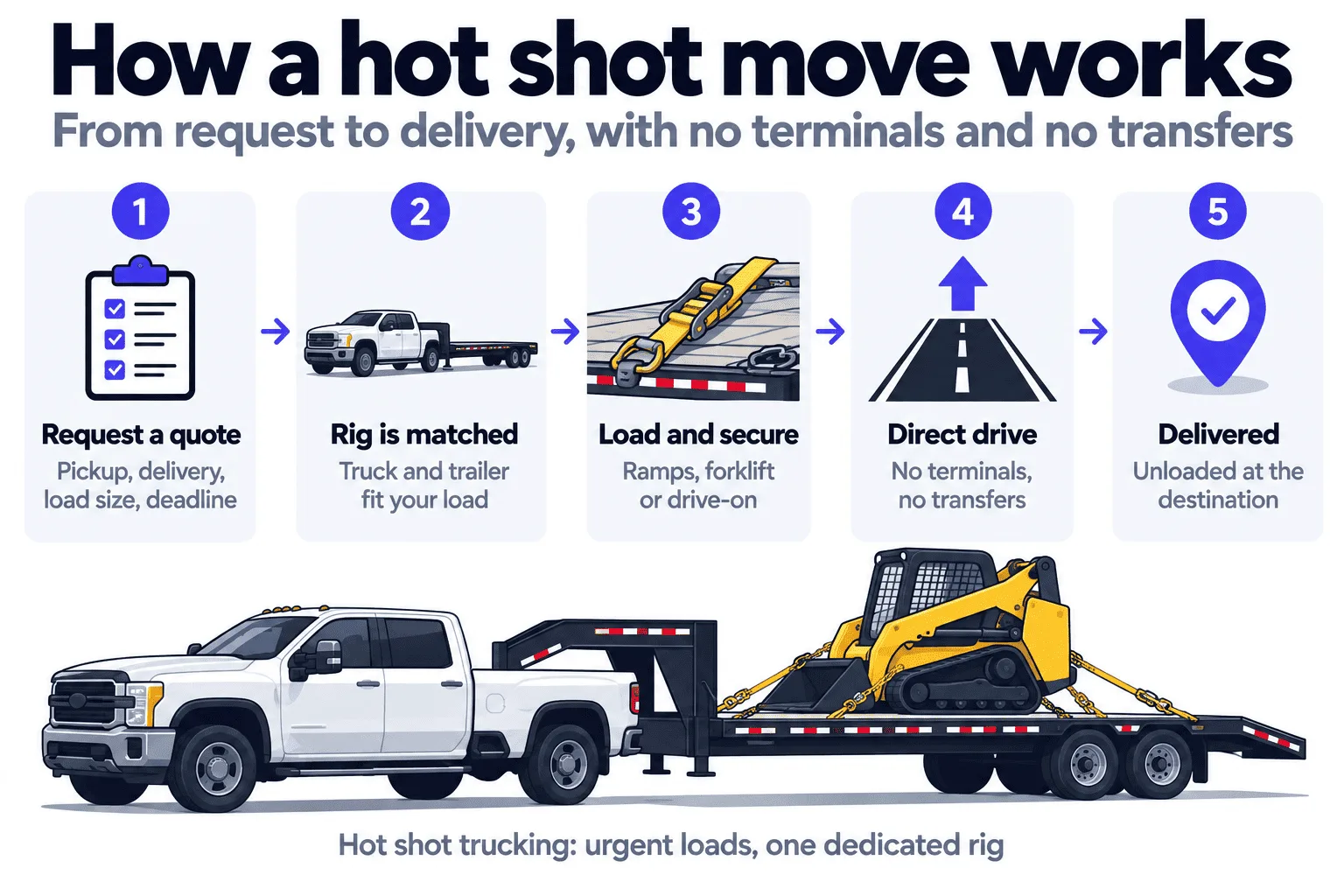
Many hot shot runs are regional and finish within a day, depending on distance. Federal hours-of-service limits apply to vehicles rated over 10,000 lb, so a long run can take more than one day.
The term is commonly traced to the oilfield, where crews needed critical parts and equipment delivered fast. The service has since spread to construction, agriculture, manufacturing and other industries.
Securement matters. Freight on an open trailer is held down with tie-downs, chains or straps rated for the load, and federal cargo securement rules apply to commercial vehicles. Tell the carrier if your load has an odd shape, a high center of gravity or a finish that scratches easily, so the right securement and covers are used.
What equipment does hot shot trucking use?
Trucks. Hot shot rigs are typically heavy-duty pickups, often a one-ton dually such as a Ford F-350 or Ram 3500, or medium-duty Class 3 to 5 trucks. By weight rating (GVWR), Class 3 is 10,001 to 14,000 lb, Class 4 is 14,001 to 16,000 lb and Class 5 is 16,001 to 19,500 lb.
Trailers. The trailer is chosen for the load:
| Trailer | Best for | Trade-off |
|---|---|---|
| Bumper-pull flatbed | Lighter, smaller loads | Lower capacity; less stable with heavy loads |
| Gooseneck flatbed | Heavier loads, longer decks | Costs more; needs a bed-mounted hitch |
| Lowboy | Tall or heavy equipment | Less deck space |
| Tilt deck | Equipment that rolls on | Hydraulics need maintenance |
| Dovetail | Vehicles and wheeled machines | Low rear can scrape on steep ramps |
Capacity. What a rig can carry depends on the ratings of the truck and the trailer, not on a single number. When you request a quote, give the true weight and dimensions so the right rig is sent.
Non-CDL vs. CDL hot shot
You will see both terms. The difference is the combined weight rating of the truck and trailer, not the job.
Non-CDL hot shot is the most common setup: a one-ton pickup with a flatbed or gooseneck trailer, with a combined rating below 26,001 lb. It costs less to buy and run, and it handles smaller equipment, parts and materials.
CDL hot shot uses larger rigs, such as medium-duty trucks with heavier trailers, or any combination rated 26,001 lb or more. It can carry heavier equipment on bigger decks, but it requires a commercial driver’s license, which is Class A when the trailer is rated over 10,000 lb. Neither is better in general. The right rig is the one that matches the load.
What does a hot shot truck haul?
Typical hot shot freight is a single piece or a few pieces that need an open deck:
- Construction equipment such as skid steers, compactors and small excavators
- Machinery, industrial and agricultural equipment
- Oilfield and utility parts and equipment
- Building materials and long items such as pipe, lumber and steel
- Vehicles, ATVs and trailers
- Urgent parts that are needed on a job site today
Hazardous materials need the correct placarding and driver endorsements regardless of vehicle size. If your freight is boxed, palletized or needs protection from weather, a Sprinter van, cargo van or box truck is usually a better match.
Hot shot vs. Sprinter van, box truck and LTL
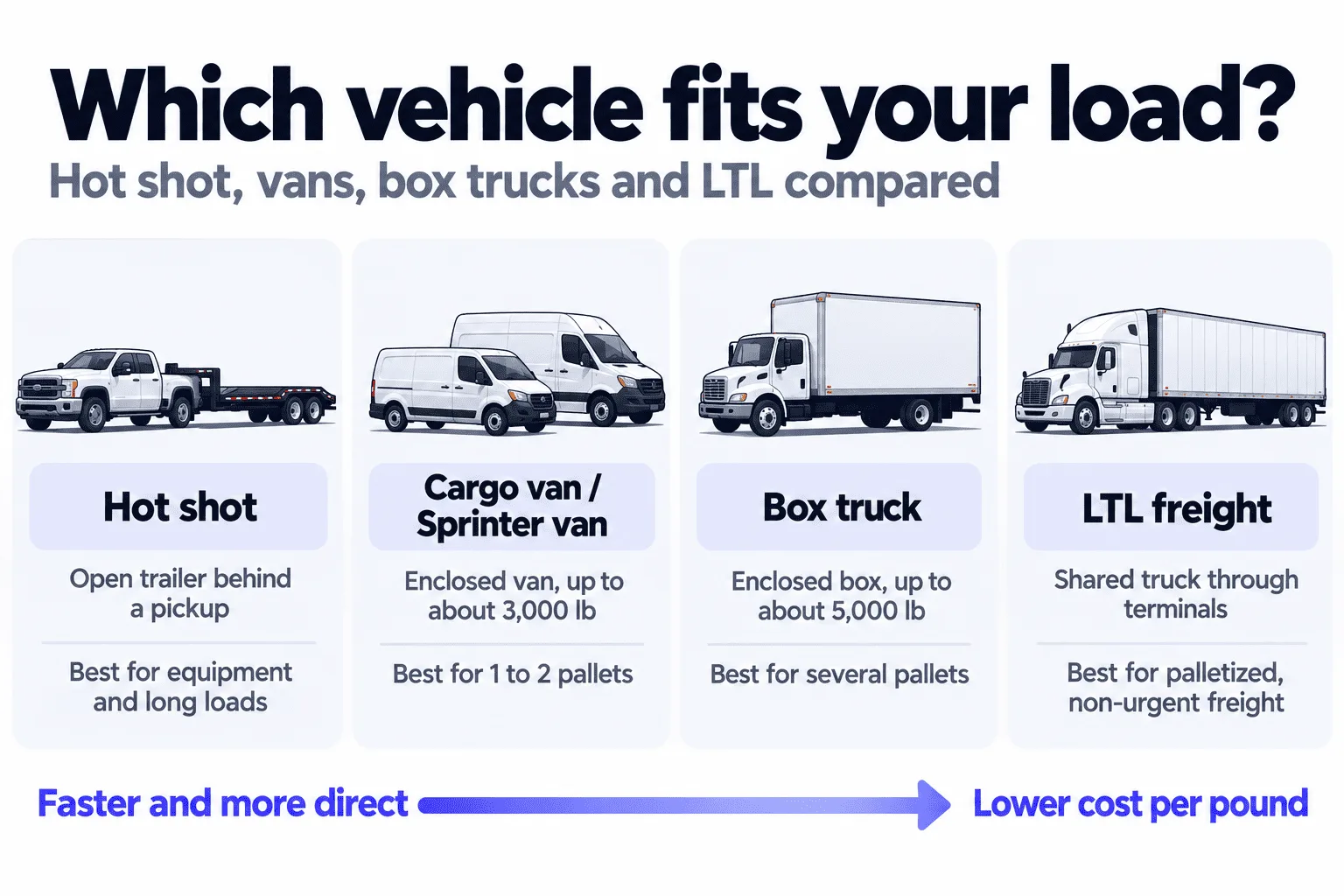
| Option | How it carries freight | Best for | Trade-off |
|---|---|---|---|
| Hot shot | Open trailer behind a pickup | Equipment, machinery, long or awkward loads | Freight is exposed to weather |
| Cargo van / Sprinter van | Enclosed van | Small loads, up to 1 to 2 pallets (about 1,500 to 3,000 lb) | Limited size and weight |
| Box truck | Enclosed box | Several pallets (up to about 5,000 lb) | Cannot carry tall or open-deck loads |
| LTL freight | Shared truck through terminals | Palletized, non-urgent freight | Slower, with multiple handling points |
Which vehicle usually fits your load?
| Your load | Usually fits | Why |
|---|---|---|
| A skid steer or small compactor | Hot shot with a gooseneck or flatbed trailer | Heavy, rolls on, and needs a deck and ramps |
| 20 ft of pipe, lumber or steel | Hot shot with a flatbed trailer | Longer than a van’s cargo area |
| An ATV or small utility trailer | Hot shot with a dovetail or tilt deck | Loads by driving or rolling it on |
| A single pallet or a few boxes | Cargo van or Sprinter van | Smallest and usually cheapest vehicle |
| Two to six pallets of parts | Sprinter van or box truck | Enclosed and forklift-friendly |
| Many pallets, no rush | LTL freight | Shared truck, lowest price |
If you need an enclosed vehicle, see our expedited freight services, including Sprinter van and cargo van delivery. If your shipment is not urgent, LTL freight is usually cheaper.
Do you need a CDL, USDOT number or operating authority?
These are the general federal rules. Check the current rules and your state’s requirements before you operate.
- CDL. A commercial driver’s license is required for a vehicle or combination rated 26,001 lb GVWR/GCWR or more. A combination rated below 26,001 lb does not need one, unless it carries placarded hazardous materials. The combination is Class A when it is rated 26,001 lb or more and the trailer is rated over 10,000 lb. This is why many hot shot rigs are “non-CDL”. These are the manufacturer’s weight ratings, not the weight on a scale. (FMCSA, 49 CFR 383.91)
- USDOT number. FMCSA requires one for interstate commerce when the vehicle or combination is rated 10,001 lb or more. Many one-ton dually pickups are rated over 10,000 lb, so interstate hot shot work usually brings this requirement. Some states also require one for intrastate work. (FMCSA: Do I need a USDOT number?)
- Operating authority (MC number). For-hire carriers moving freight across state lines generally need FMCSA operating authority. (FMCSA: Operating authority)
- Insurance. Carriers need commercial insurance, including liability and cargo coverage. Requirements vary by state and by load.
- Driver rules. Vehicles over 10,000 lb are generally subject to hours-of-service limits and DOT medical qualification.
This is general information, not legal advice.
What does hot shot trucking cost?
Hot shot is quoted per load, not from a rate sheet, because loads vary so much. What moves the price:
- Distance, and whether the driver has to return empty
- Urgency: same-day, after-hours and weekend runs cost more
- The load: weight, length and the trailer it needs
- Loading and unloading: whether a forklift, crane or ramps are needed
- Capacity near your pickup: if few rigs are nearby, the price goes up
- Fuel
Transportli Tip: Keep the price down
Give accurate weight and dimensions up front and be flexible on timing where you can. A rig sized to the load costs less than a larger one sent “just in case”.
How to get a hot shot quote
Have this ready so your load can be matched with the right rig quickly:
- Pickup and delivery addresses, plus any access limits (gate times, low clearance, dock or no dock)
- What the load is, its weight and its length, width and height
- How it will be loaded (forklift, ramps, drive-on) and unloaded
- Your deadline
- Any special needs, such as straps, tarps or a crane
Need a hot shot load moved?
Tell us about your load and your deadline, and we will match it with a carrier.
Get a hot shot quote →Thinking about driving hot shot?
Hot shot appeals to owner-operators because the equipment costs less to buy and run than a full semi. It is also hard work: drivers are typically independent contractors who pay their own fuel, insurance, maintenance and tolls, so take-home pay is well below gross revenue.
If you want to try it, the usual steps are:
- Confirm whether your truck-and-trailer combination needs a CDL.
- Get a USDOT number and, if you haul for hire across state lines, operating authority.
- Arrange commercial insurance.
- Choose a truck and trailer that match the freight you want to haul.
- Find loads.
Drive with Transportli
Run your own Sprinter van, cargo van, box truck or hot shot rig? Apply to Transportli Drivers and we email the next steps, usually within 2–3 hours.
Hot shot trucking: frequently asked questions
What is hot shot trucking?
Hot shot trucking is a service that moves urgent, smaller loads with a heavy-duty pickup, or a medium-duty truck, pulling a flatbed or gooseneck trailer, directly from pickup to delivery.
Why is it called hot shot?
The term is commonly traced to the oilfield, where urgent (“hot”) shipments of parts and equipment had to be rushed to a site.
How does hot shot trucking work?
A carrier with a matching truck and trailer is dispatched to your pickup location, loads your freight and drives it straight to the destination without terminals or transfers.
Do you need a CDL for hot shot trucking?
Often not. A CDL is generally required when the truck and trailer together are rated 26,001 lb or more. Many hot shot rigs are rated below that. Hazmat loads can require a CDL with endorsements regardless.
Do you need a USDOT number for hot shot?
FMCSA requires a USDOT number for interstate commerce when the vehicle or combination is rated 10,001 lb or more. Some states require one for intrastate work too.
How much does hot shot trucking cost?
It is quoted per load. Distance, urgency, the size and weight of the load and the trailer needed all affect the price. Request a quote to get a price for your load.
What can a hot shot truck haul?
Open-deck freight such as equipment, machinery, building materials, long items and vehicles. Boxed or palletized freight that needs weather protection usually goes better in a van or box truck.
Is hot shot trucking worth it?
For drivers it depends on equipment costs, fuel, insurance and how consistently loads are found. Drivers are generally independent contractors who pay their own costs, so net income is well below gross revenue.
What is the difference between hot shot and LTL?
LTL moves palletized freight on a shared truck through terminals, usually in a few days. Hot shot sends a dedicated rig directly to the destination.
Can I get a hot shot quote through Transportli?
Yes. Request a quote and our team will match your load with a carrier.