LTL (less-than-truckload) means your freight shares a trailer with other shippers’ freight and you pay for the space you use. FTL (full truckload) means one shipper has the whole trailer. Between the two sits volume LTL and partial truckload, which is where many shippers with 6 to 14 pallets end up. This guide explains the differences, how to choose, and what each option cost in real quotes we pulled in October 2026.
The short answer
- 1 to 5 pallets: standard LTL is usually the right start. You pay for the space you use.
- 6 to 11 pallets: ask for volume LTL quotes as well as standard LTL. Volume LTL was the cheapest option on some of our sample lanes, but not all.
- 12 or more pallets, or a full trailer: price a partial or full truckload. Truckload also fits fragile freight, firm appointments and tight deadlines.
- Do not decide on mode alone. In our samples the same shipment varied by as much as 3 times in price between carriers, so compare quotes.
These pallet ranges are our rule of thumb. Carriers and brokers draw the lines in different places, from about 6 pallets to about 12 pallets for where LTL ends, so treat them as a starting point and let the quotes decide.
LTL vs. volume LTL vs. partial truckload vs. FTL
| Standard LTL | Volume LTL | Partial truckload | Full truckload (FTL) | |
|---|---|---|---|---|
| Typical size | About 1 to 5 pallets, 150 to 10,000 lb, up to about 12 linear feet | About 6 to 11 pallets, roughly 6,000 lb and up | About 8 to 18 pallets | 12 or more pallets, up to a full 53 ft trailer (about 26 pallets in a single layer) |
| How you share the trailer | With many other shippers | With a few other shippers, often by linear feet | With one or two other loads | Not shared |
| How it is priced | By weight, freight class, distance and accessorials | A volume rate, often built from weight and linear feet | A rate for the part of the truck you use | A flat rate for the truck, based on the lane and the market |
| Handling | Moves through terminals and may be handled several times | Fewer touches than standard LTL, but may still use terminals | Usually direct or with few stops | Usually loaded once and delivered direct |
| Transit in our sample quotes | 1 to 8 days (most 2 to 5), delivery dates are estimates | Often slower: the cheapest volume quote took 3 to 8 days | Often faster than LTL | Usually the fastest. Direct to the destination |
| Pickup | Pickup windows, not a fixed time | Pickup windows | Usually a scheduled pickup | Usually a firm appointment |
| Extra charges | Common: liftgate, residential, limited access, reweigh, reclass | Similar to standard LTL | Fewer | Fewer, though waiting time (detention) can apply |
| Freight class | Needed | Needed | Usually not | Not used for pricing |
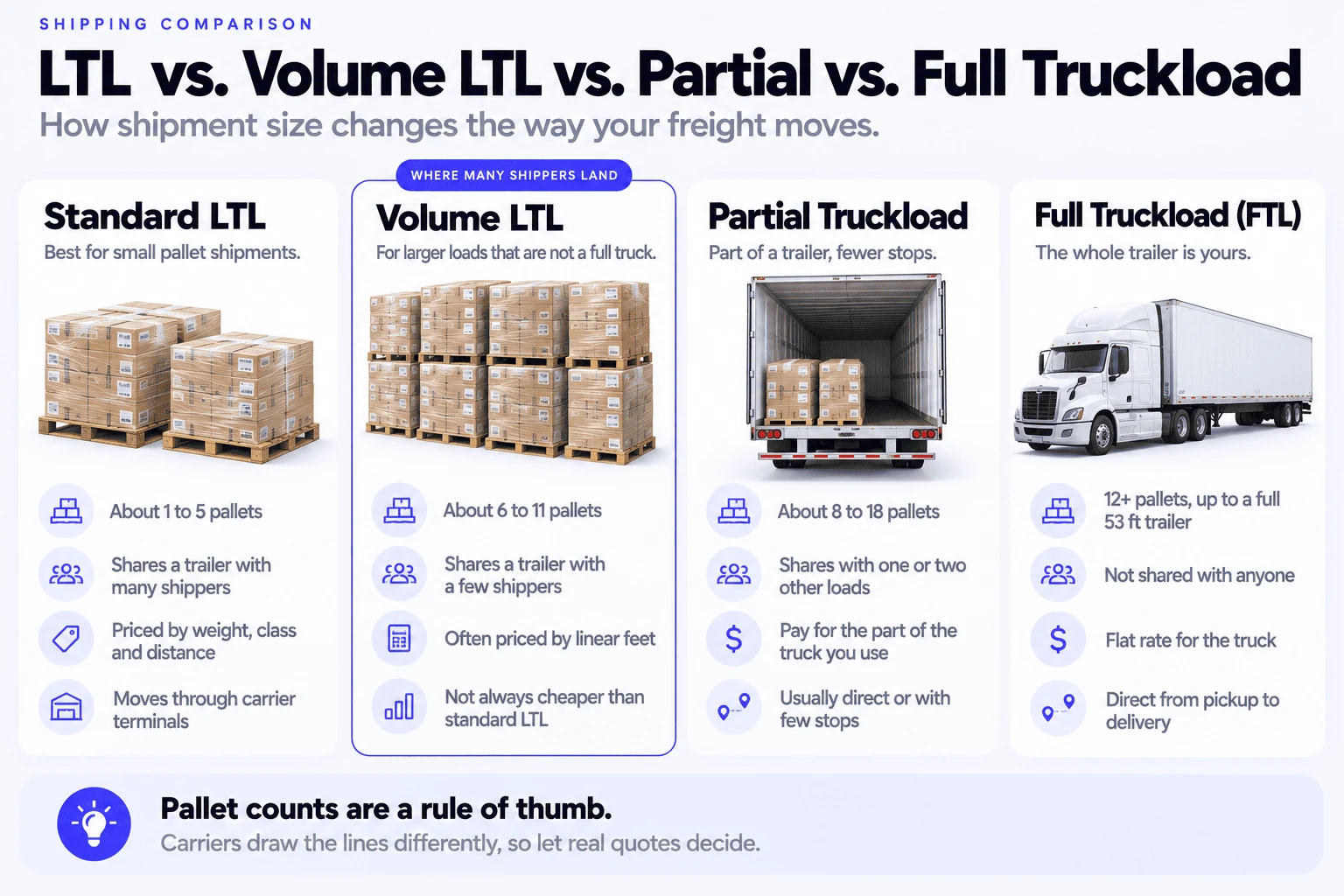
The sizes and transit times in the first rows are typical ranges, not rules. Each carrier sets its own limits, and our sample quotes are described further down.
What is LTL freight?
LTL is for shipments too small to fill a trailer. A carrier picks up your freight, usually takes it to a terminal, combines it with other freight going the same way, and delivers it from a terminal near the destination. Prices come from the freight class, weight, distance and any extra services. Our guide to LTL freight covers the details, and the freight class guide explains how class sets the price.
What is volume LTL?
Volume LTL is for larger shipments that are still not worth a full truck, commonly from about 6 pallets or when the freight takes up a lot of trailer length. Carriers often price it by linear feet of trailer space as well as weight, and it often needs to be requested specifically. It is not always cheaper than standard LTL, and it can be slower. We show both in the explorer below.
What is partial truckload?
Partial truckload (also called partial or shared truckload) sits between volume LTL and a full truck. You use part of a trailer, usually from about 8 pallets up, with one or two other loads or with empty space left. It suits freight that is too big for LTL but does not fill a trailer, and it can move faster than LTL because it makes fewer stops.
What is full truckload (FTL)?
With FTL the whole trailer is yours, usually a 53 ft dry van. The truck goes from pickup to delivery without mixing in anyone else’s freight. You pay for the truck, whether or not it is full, so the price depends on the lane and the truckload market, not on freight class. Truckload suits large or heavy loads, fragile or high-value freight, and firm delivery dates.
How to choose between LTL and FTL
- Start with the size of the load. Count the pallets, weigh them, and measure the total length they take in a trailer. Under about 6 pallets points to standard LTL, about 6 to 11 to volume LTL, and 12 or more to a partial or full truckload. The pallet shipping guide and the density calculator help you size a shipment.
- Look at your deadline. Standard LTL gives estimated delivery dates and pickup windows. A guaranteed LTL option exists, and in our samples it cost noticeably more than standard. If delivery has to be on a certain day, a truck dedicated to your freight, or an expedited service, is safer.
- Think about handling and risk. LTL freight is loaded and unloaded more often, so packaging matters more. Fragile, high-value or temperature-sensitive freight, or freight that must not be mixed with other loads, is a reason to look at a truck.
- Compare the real prices. LTL is usually cheaper per shipment at small sizes because you pay for the space you use. As the load grows, the gap narrows and on some lanes the truck wins. The explorer below shows how this played out on five lanes.
- Consider how often you ship. A single load and a weekly lane are different problems. Regular volume on one lane can justify a contract truckload rate or a scheduled service.
Which is cheaper, LTL or FTL? Real quotes on five lanes
We asked our quoting platform for LTL quotes on the same shipment at four sizes on five lanes, and compared them with the truckload market rate for a dry van on each lane. The explorer shows the best standard LTL quote, the best volume LTL quote where carriers returned one, the typical (median) LTL quote, and the truckload rate.
LTL vs. truckload cost explorer
Pick a lane and a shipment size to see the best LTL quote, the typical LTL quote and the truckload market rate side by side.
What the samples show
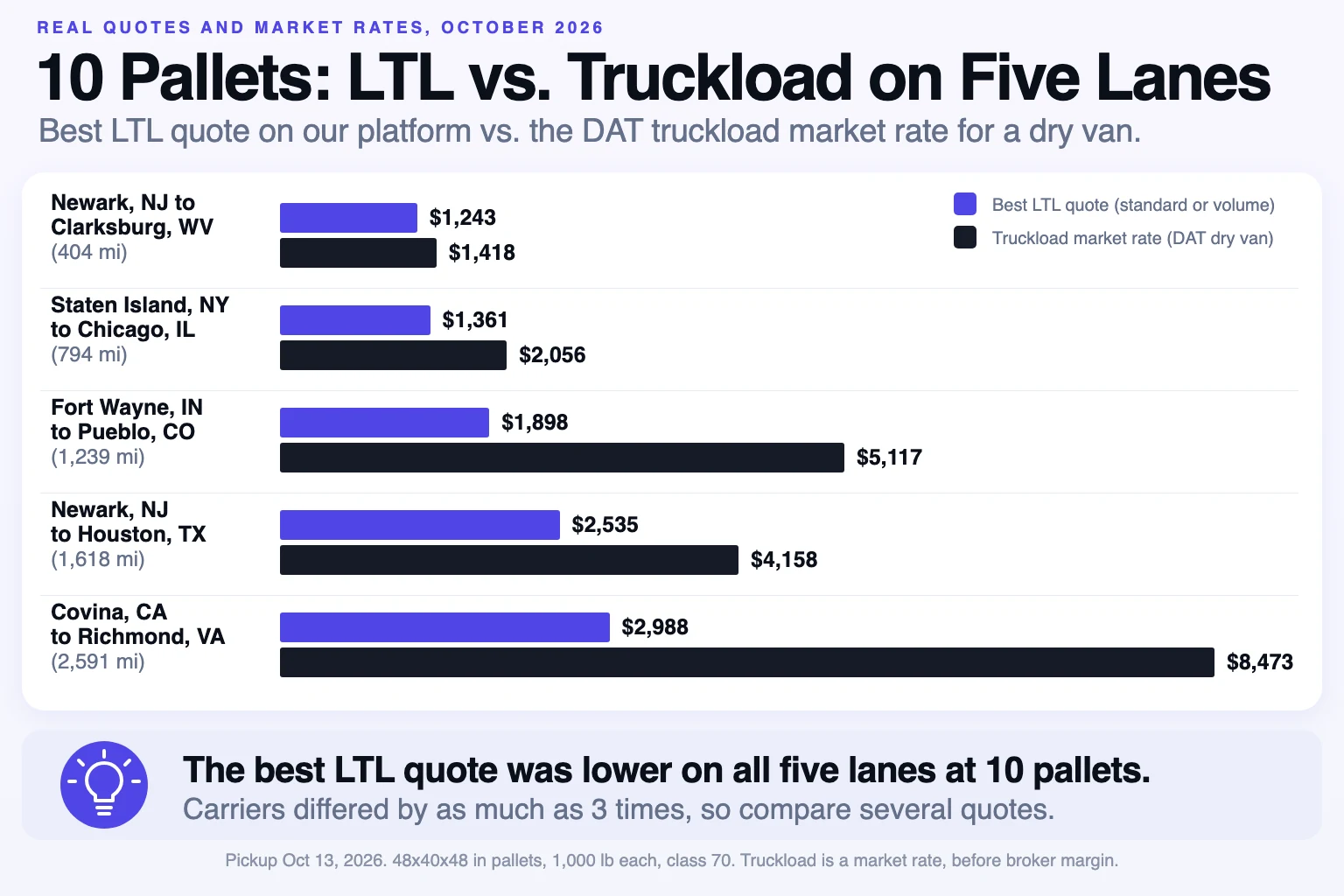
- The best LTL quote beat the truckload market rate almost everywhere. It was lower at every size on every lane we tested, except 14 pallets on the shortest lane (404 miles), where the truck was about $200 cheaper.
- The typical LTL quote often did not. At 14 pallets, the median LTL quote was above the truckload rate on three of five lanes. Carriers differed by as much as 3 times on the same shipment, so getting several quotes is worth more than choosing the mode.
- Volume LTL helps on some lanes, not all. It was the lowest LTL option at 6 to 14 pallets on Staten Island to Chicago, from 10 pallets on Covina to Richmond and at 14 pallets on Newark to Houston. Standard LTL was cheaper at every size on Newark to Clarksburg and Fort Wayne to Pueblo. Only four or five carriers returned volume quotes, and the cheapest ones took 3 to 8 days.
- Truckload prices swing by lane. LTL moves less. The truckload spot rate ran from $2.57 to $4.13 per mile across these lanes, with Fort Wayne to Pueblo at the top. LTL carriers price from tariffs and discounts, so their prices usually vary less from lane to lane.
How to read these numbers
The LTL figures are real quotes from carriers on our platform for a Tuesday, October 13, 2026 pickup. Each pallet is 48 × 40 × 48 in, 1,000 lb, freight class 70, dock to dock, with no accessorials. We use each carrier’s lowest standard quote and drop quotes that are clearly broken, such as a few that came back at five to 20 times the rest. The truckload figures are DAT dry van market rates, looked up on October 11, 2026. They show what trucks are being paid on the lane, not a price a shipper would be quoted. A broker adds a margin on top, so a shipper’s truckload price would be higher. These are samples from one day, not a price list.
Not sure which mode fits? Answer three questions
This short quiz points you to standard LTL, volume LTL, expedited or truckload based on your freight, then lists accessorial tips for pickup and delivery.
Which shipping mode fits your freight?
Answer three quick questions to see whether standard LTL, volume LTL, expedited or truckload is the better starting point, and what to watch for at pickup and delivery.
Where an LTL quote can grow
The headline LTL price is only part of what you can end up paying. Truckload has fewer of these, though waiting time can add to a truck bill too. Check these before you compare:
- Reweigh and reclass. LTL carriers measure and weigh freight. If your weight, size or class is off, the price is adjusted. Use the freight class calculator and write an accurate bill of lading with the bill of lading generator.
- Accessorials. Liftgate, residential delivery, limited access, inside delivery and appointments are charged separately. The accessorial charge checker shows which ones your pickup and delivery locations are likely to trigger.
- Guaranteed service. A guaranteed delivery option costs more than standard in every sample we pulled.
- Fuel. LTL quotes in our samples included fuel. Truckload rates may be quoted with fuel included or added separately, so ask.
Four example shipments
| Shipment | What our samples showed | Usually the better fit |
|---|---|---|
| 3 pallets, 3,000 lb, Staten Island, NY to Chicago, IL (794 mi) | Best LTL quote $798, typical $1,315. Truckload market rate about $2,056. | Standard LTL |
| 10 pallets, 10,000 lb, Fort Wayne, IN to Pueblo, CO (1,239 mi) | Best standard LTL $1,898, best volume LTL $2,659. Truckload market rate about $5,117. | LTL, with standard ahead of volume on this lane |
| 14 pallets, 14,000 lb, Newark, NJ to Clarksburg, WV (404 mi) | Best LTL quote $1,623, typical $2,357. Truckload market rate about $1,418. | Truckload. Price it and compare |
| 1 pallet that must arrive tomorrow | LTL gives estimated dates and pickup windows. A truck dedicated to the load fits better. | Expedited freight, a Sprinter van or a cargo van |
When neither LTL nor FTL fits
Some freight does not fit the standard modes. One or two pallets that need to arrive in hours is an expedited freight job, handled by a dedicated Sprinter van, cargo van or box truck. Freight that is heavy or oversized and needs a pickup and trailer is often a hot shot load. Our expedited pages show what each costs.
Compare LTL quotes for your shipment
Enter your pickup and delivery details and see quotes from several carriers, including volume LTL where it applies.
Get an LTL quote →LTL vs. FTL: frequently asked questions
What is the difference between LTL and FTL?
LTL (less-than-truckload) shares a trailer with other shippers’ freight and you pay for the space you use. FTL (full truckload) gives you the whole trailer. LTL is priced by weight, freight class and distance. FTL is priced per truck based on the lane and the market.
How many pallets is LTL?
Standard LTL is usually 1 to 5 pallets, though carriers draw the line anywhere from about 6 to 12 pallets. Our rule of thumb is 1 to 5 pallets for standard LTL, 6 to 11 for volume LTL and 12 or more for partial or full truckload.
What is volume LTL?
Volume LTL is for larger shipments, commonly from about 6 pallets or when freight takes a lot of trailer length. It is often priced by linear feet and sometimes needs to be requested specifically. It can be cheaper than standard LTL, but it was not cheaper on every lane in our samples, and it can be slower.
What is partial truckload?
Partial truckload uses part of a trailer, usually from about 8 pallets, with one or two other loads. It sits between volume LTL and a full truck and can be faster than LTL because it makes fewer stops.
Is LTL cheaper than FTL?
Often, but not always. In our October 2026 samples the best LTL quote beat the truckload market rate on all five lanes at most sizes. The one exception was 14 pallets on the shortest lane (404 miles). The typical LTL quote did not beat the truck on several lanes at 14 pallets, so compare quotes for your own shipment.
When should I use FTL instead of LTL?
Consider a truckload for 12 or more pallets, a heavy load, fragile or high-value freight that should not be handled repeatedly, a firm delivery date or appointment, or a lane where truckload prices are low.
Is LTL slower than FTL?
Usually. LTL freight moves through terminals and delivery dates are estimates. In our sample quotes standard LTL took 1 to 8 days (most 2 to 5), and the cheapest volume LTL quotes took 3 to 8. A truck goes direct, so it is usually the fastest option, though a driver’s hours of service still apply.
Does LTL have a higher risk of damage?
LTL freight is handled more often, so the risk of damage is higher than on a truck that is loaded once. Good packaging, palletizing and clear labeling reduce it. Carriers’ liability is limited, so consider insuring valuable freight.
Do I need a freight class for FTL?
No. Freight class is used to price LTL shipments. Truckload is priced per truck. You still need an accurate bill of lading for both.
What is the weight limit for LTL?
Many carriers handle about 150 lb up to about 10,000 lb per shipment, and some accept more. A single pallet, the total length in the trailer and the carrier’s own rules all matter, so check before you book.
Can I mix LTL and FTL?
Yes. Many shippers use LTL for small or irregular shipments and move up to volume LTL or truckload on busy lanes or at peak times. It is worth re-checking the mode as your volume changes.