A transmission is one of the easiest big parts to ship well and one of the easiest to ship badly. It weighs 100 to 500 lb, it is awkward to lift, it is full of fluid until you drain it, and the sellers who get it wrong usually find out at pickup, when the driver refuses a leaking unit, or two weeks later, when the buyer opens a cracked bell housing. This guide walks through the whole job: whether to use parcel or freight, how much it weighs, how to prepare and pack it, what freight class it falls into after the 2025 change, what it costs (using real quotes), and what to do on pickup and delivery day. Use the planner below to get your own weight, size, class and checklist as you go.
The short version
- Almost every transmission ships best as LTL freight on a pallet, skid or crate. Most carry a package limit around 150 lb on parcel networks, and many units are over it once packed.
- Drain it, plug it, strap it. Fluid out, openings capped, torque converter secured, unit bolted or strapped to the base and inside the edges of the pallet.
- Pack on the smallest stable base. Carriers measure the outside of the load, so empty pallet space can push the class up. The planner below shows all three bases side by side.
- Freight class is now set by density (13-step scale, effective July 19, 2025). Older guides that say “transmissions are always class 85” are out of date.
- Real quotes on our platform for 150 to 450 lb shipments had a median lowest price of about $388, but it ranged from about $239 to over $1,800 depending on the lane. Compare live quotes before you book.
- Weigh, measure and photograph the finished load, put the true numbers on the bill of lading and note any damage on the delivery receipt before you sign.
Can you ship a transmission by UPS or FedEx, or do you need freight?
Sometimes you can, usually you should not. Parcel networks are built for boxes that a person or a conveyor can move. Most parcel carriers publish a limit of about 150 lb per package, along with length and length-plus-girth limits, and they add surcharges well before those limits when a package is heavy or oversize. A bare transaxle or manual gearbox can fit in a heavy box and ride parcel. A typical automatic, a diesel unit, or anything on a pallet will not, or will cost more than freight once surcharges are added. Check each carrier’s current rules before you book; they change.
| What you are shipping | Usually best by | Why |
|---|---|---|
| Manual gearbox or transfer case, well under 100 lb packed, in a strong box | Parcel (compare with LTL) | Fits parcel limits, but large-package and additional-handling surcharges can erase the savings. Get both prices. |
| Automatic transmission or transaxle, about 150 to 300 lb packed | LTL freight | Over parcel limits once boxed or skidded; freight carriers move palletized loads this heavy daily. |
| Heavy-duty or diesel truck transmission, 300 lb and up | LTL freight | Weight and handling require a forklift and a real base. |
| Transmission plus torque converter, shifter, cooler and bracket hardware | LTL freight | One consolidated skid is safer and cheaper than several parcels. |
| Complete drivetrain (engine, transmission, differential) | LTL freight, or a flatbed for very large loads | See our auto parts shipping guide for engines and other heavy assemblies. |
If you are new to freight, read what LTL freight is first. The short version: your shipment rides on a shared truck, you pay for the space and weight it takes, and it is handled with a forklift at every terminal.
How much does a transmission weigh?
Weight is the first number every quote asks for, and it is the one people most often guess. Typical bare, drained weights are below. They are ranges from commonly published specifications, not exact figures for your unit, so weigh yours. A bathroom scale under a pallet jack or a floor scale at a local shop works.
| Type of unit | Typical bare weight | Typical packed weight on a base |
|---|---|---|
| Manual transmission (car or light truck) | 100 to 200 lb | 135 to 245 lb |
| Automatic transmission (car, SUV, half-ton pickup) | 140 to 260 lb | 175 to 305 lb |
| Transaxle (front-wheel or all-wheel drive) | 90 to 220 lb | 125 to 265 lb |
| Transfer case | 60 to 180 lb | 95 to 225 lb |
| Heavy-duty or diesel truck transmission | 280 to 500 lb | 315 to 545 lb |
“Packed weight” adds a base: about 35 lb for a small wood skid, about 45 lb for a standard pallet, and roughly 15% more (at least 40 lb) for a crate. Carriers bill on the weight they measure at the terminal, so the number you put on the bill of lading should match what a scale says.
Transmission shipping planner
Pick your type of unit, adjust the weight and size to match yours, and choose a base. The planner shows the density and estimated freight class for a small skid, a standard pallet and a crate side by side, tells you whether parcel is realistic, compares your numbers against real quotes, and gives you a tick-off checklist and a copy-ready bill of lading description.
Transmission shipping planner
Pick the unit, enter its weight and size, and see how it should be packed, what freight class carriers will likely apply, whether it can go parcel, and what real LTL quotes cost for a load this heavy.
How to prepare a transmission for shipping: 12 steps
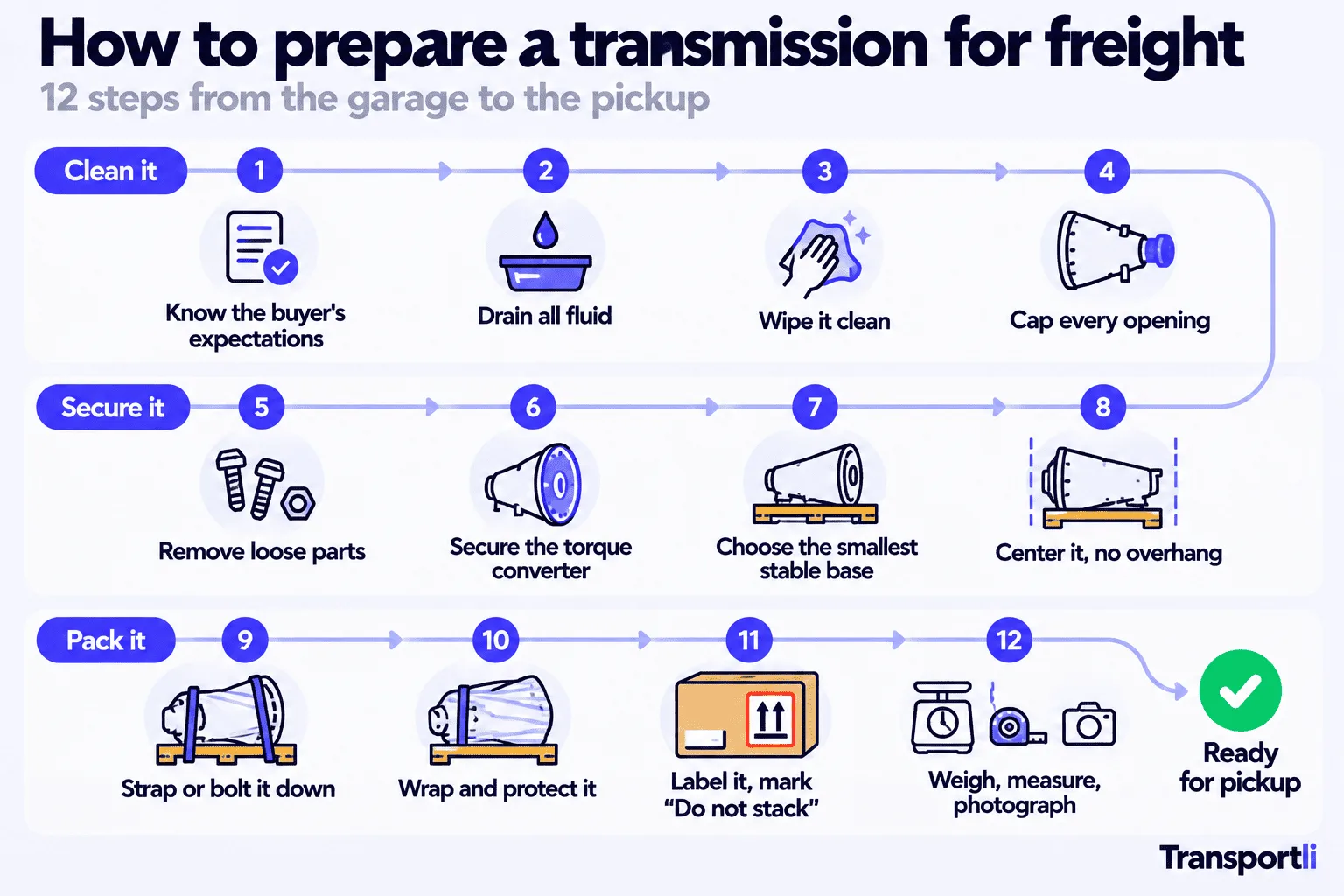
- Check what the buyer or carrier expects. A salvage buyer may not care about cosmetics; a rebuilder or a remanufactured-unit customer will. Know what condition you are describing.
- Drain all the fluid. Pull the drain plug (or pan), let it drip for a while, and tip the unit to clear the cooler ports. Dispose of the fluid properly. A unit that weeps oil can be refused at pickup and will stain everything near it.
- Wipe it down. A clean, dry housing lets the driver see there are no leaks, and it makes your photos useful if there is a claim.
- Plug and cap every opening. Cooler-line ports, the input shaft opening and the tail housing should be capped or covered so dirt, water and packing debris stay out.
- Remove loose and fragile parts. The shift console or linkage, speed sensors, wiring harness ends and any bracket that sticks out are the first things to snap. Bag them, label the bag and ship them in a small box that stays with the unit.
- Secure the torque converter. On automatics it can slide forward out of the bell housing and spill what is left of its fluid. Tape or strap it so it cannot move.
- Choose the base. Use a sound, clean wood skid or pallet, or a crate for high-value or remanufactured units. The smallest stable base is usually the best (see the class section below).
- Position the unit. Set it the way it was designed to sit, usually bell housing down on an automatic, and center it. Nothing should hang over the edge of the base.
- Fasten it down. Strap it through the base with edge protectors, or bolt it to the base through its mounting points. Add blocks so it cannot slide. Stretch wrap by itself is not a restraint.
- Protect it. Wrap it in a moving blanket or double-wall cardboard, then shrink wrap or stretch wrap. Add corner protectors if the load will have exposed edges.
- Label it. Put the consignee name and address, your reference and the weight on two sides, and mark it “Do not stack”. Remove or cover old labels from previous shipments.
- Weigh, measure and photograph. Take the final weight and length, width and height of the finished load (including the base), and photograph all sides. Those numbers go on the bill of lading.
Fluid out, openings capped
The most common reason for refusal at pickup is a wet unit.
Converter and loose parts secured
A sliding converter or a snapped sensor is a damage claim waiting to happen.
Centered on a base, nothing overhanging
Overhang can be refused, re-measured or damaged by passing forklifts.
Photos of all sides before pickup
Your best evidence if you need to file a claim.
Pallet, skid or crate: which should you use?
There is no single right answer. A standard 48″ × 40″ pallet is easy to find and every terminal handles it. A smaller skid can lower the class and the price. A crate gives the best protection but adds weight and cost. The planner above computes the exact numbers for your unit. As a rule of thumb:
| Base | Best for | Watch out for |
|---|---|---|
| Small skid (about 40″ × 30″) | Most used automatics and manuals that fit inside its edges | The unit must sit fully inside the edges. Overhang is the thing carriers refuse. |
| Standard pallet (48″ × 40″) | Larger or odd-shaped units, or when you also ship other parts | Empty pallet space is billable space and can raise the class. |
| Wood crate | Remanufactured, high-value or long-distance units; international or repeat shipping | Adds size and weight, and costs money to build. It can move you to a higher class. |
What freight class is a transmission in 2026?
Freight class is the NMFC category carriers use to price a shipment: the higher the class, the higher the rate. On July 19, 2025 the National Motor Freight Traffic Association changed the rules for a long list of commodities, including most automobile parts, so that class is set by density (pounds per cubic foot of the finished load) on a 13-step scale. Many older articles still say transmissions are “always class 85”. That was a fixed class under the old item; today it depends on the numbers you hand the carrier. Our freight class guide explains the system in full, and the density calculator works out any shipment.
| Density (lb per cubic foot) | Freight class |
|---|---|
| Less than 1 | 400 |
| 1 to less than 2 | 300 |
| 2 to less than 4 | 250 |
| 4 to less than 6 | 175 |
| 6 to less than 8 | 125 |
| 8 to less than 10 | 100 |
| 10 to less than 12 | 92.5 |
| 12 to less than 15 | 85 |
| 15 to less than 22.5 | 70 |
| 22.5 to less than 30 | 65 |
| 30 to less than 35 | 60 |
| 35 to less than 50 | 55 |
| 50 or greater | 50 |
Worked examples for a typical 190 lb automatic, volume = length × width × height ÷ 1,728, using the outside size of the finished load:
| Setup | Load size (L × W × H) | Weight | Density (lb/cu ft) | Class |
|---|---|---|---|---|
| On a 40″ × 30″ skid | 40″ × 30″ × 28″ (19.4 cu ft) | 225 lb | 11.6 | 92.5 |
| On a 48″ × 40″ pallet | 48″ × 40″ × 28″ (31.1 cu ft) | 235 lb | 7.6 | 125 |
Why the base matters
In the first two rows the transmission is identical. Moving it from the standard pallet to the small skid cuts the measured volume by more than a third, which moves it from class 125 to class 92.5 on the density scale. A lower class generally means a lower rate. These are estimates: the carrier’s measured weight and dimensions decide the billed class, and carriers can re-weigh and re-measure and reclass the shipment.
How much does it cost to ship a transmission by freight?
Price depends on weight, distance, class, the pickup and delivery locations and any extras. To give you something better than a rule of thumb, we pulled the real quotes from the state pages on this site: for shipments of 150 to 450 lb, which covers most transmissions on a base, there were 83 lanes across 38 states. For each lane we recorded the lowest price returned and the fifth-lowest price returned on our platform. These are snapshots from our own testing, not guarantees.
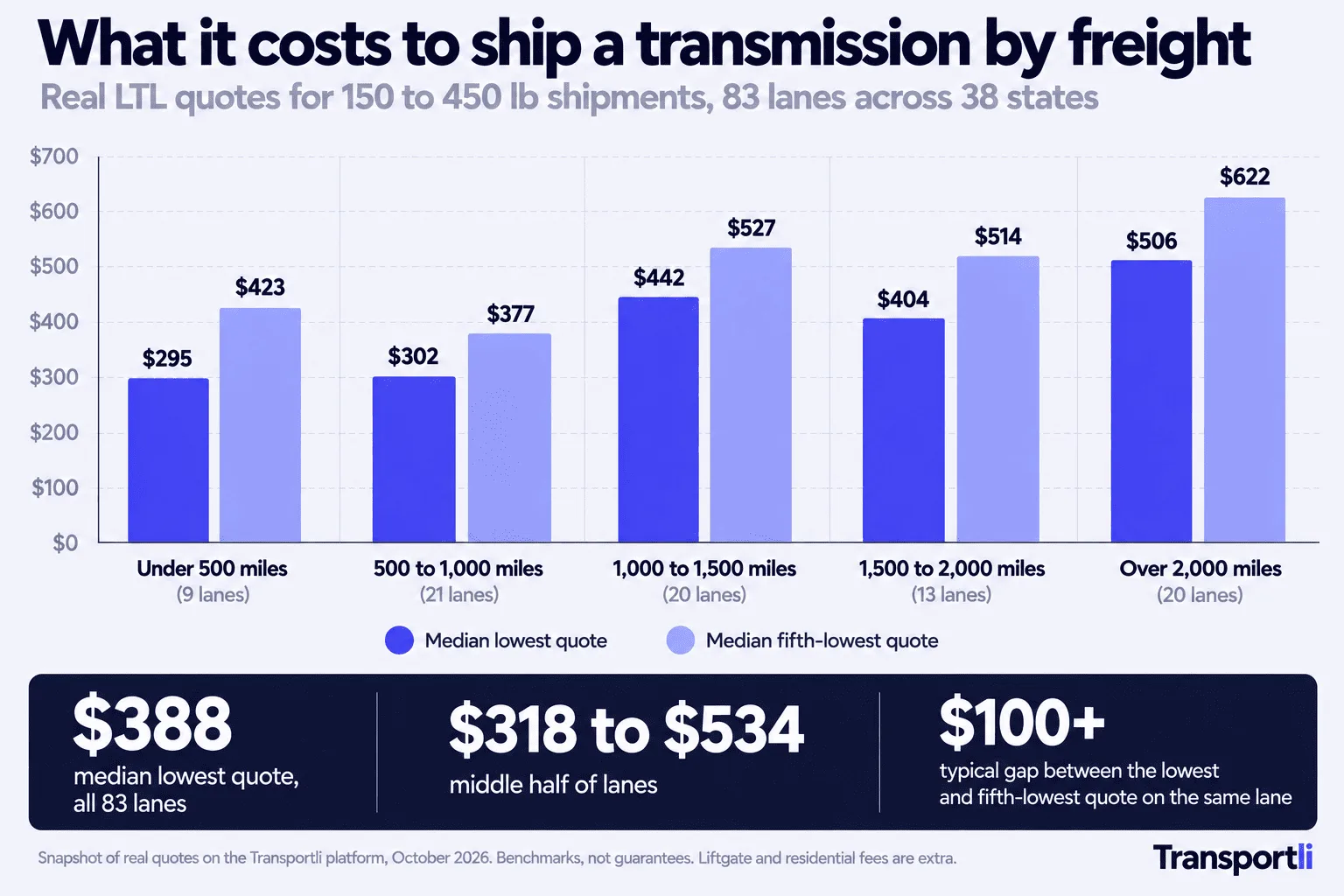
| Distance | Lanes | Median lowest quote | Middle half of lanes | Median fifth-lowest quote |
|---|---|---|---|---|
| Under 500 miles | 9 | $295 | $288 to $388 | $423 |
| 500 to 1,000 miles | 21 | $302 | $284 to $358 | $377 |
| 1,000 to 1,500 miles | 20 | $442 | $347 to $561 | $527 |
| 1,500 to 2,000 miles | 13 | $404 | $361 to $534 | $514 |
| Over 2,000 miles | 20 | $506 | $396 to $665 | $622 |
| All distances | 83 | $388 | $318 to $534 | $498 |
Two things stand out. First, distance matters less than you would expect: a 500-mile lane and an 800-mile lane were close, because a shipment this small is mostly priced by minimum charges, pickup and delivery. Second, the spread between the lowest and the fifth-lowest quote on the same lane was typically $100 or more. That gap is why comparing carriers is worth the few minutes. The benchmark inside the planner above lets you filter by your own weight and distance.
Extras that change the price
Liftgate, residential delivery, limited-access locations and inside delivery are charged on top of the base rate. Our accessorial charge checker shows what each typically adds. Delivering to a shop with a dock is usually cheaper than delivering to a home.
- A residential delivery of a 200 to 300 lb crate almost always needs a liftgate. Ask the buyer if they have a forklift or a loading dock.
- Terminal pickup (the buyer collects from the carrier’s local terminal) can save the delivery extras entirely.
Standard LTL, volume LTL, expedited or truckload?
A single transmission nearly always belongs in standard LTL. If you are moving several (a dismantler, a rebuilder, a parts store), the answer changes. Try the quiz below.
Which shipping mode fits your freight?
Answer three quick questions to see whether standard LTL, volume LTL, expedited or truckload is the better starting point, and what to watch for at pickup and delivery.
Selling a transmission on eBay or a marketplace
Freight is where many used-transmission listings lose money. Some practical points:
- Quote before you list. Get a freight quote to a few zip codes (near, far, and a residential one) and put the price into the listing or the shipping calculator. Buyers do not like surprises, and neither does your feedback score.
- Offer freight shipping and local pickup. Local pickup on a heavy unit often sells faster than waiting for a buyer to accept a $400 freight charge.
- State the shipped weight and size in the listing. It reduces disputes, and you will need them for the bill of lading anyway.
- Check the marketplace’s own shipping rules and the carriers it supports. They change, and some require you to ship within a set time after payment.
- Document everything. Photos of the unit before packing, after packing, and at pickup are the evidence if a buyer claims it arrived damaged or not as described.
Describing a transmission on the bill of lading
The bill of lading is the contract between you and the carrier. Accurate numbers keep you out of reweigh and reclass fees. A good description includes the condition, what it is, how many pieces, the packaging, the true weight, the true outside dimensions and any handling note. For example:
Example description
“Used auto parts: automatic transmission (drained), 1 skid, 40 x 30 x 28 in, 225 lb. Do not stack.”
You can build your own in the planner above, or use the bill of lading generator to produce the full document. Include a phone number for the pickup and delivery contacts; missed appointments are a common source of redelivery fees.
Pickup day and delivery day
At pickup
- Have the unit on the ground floor or on a dock, with a forklift or pallet jack available if the driver needs it (many trucks have only a pallet jack).
- Be there, or have someone there, in the pickup window. Missed pickups can be billed.
- Hand over the bill of lading with the true weight and size. Keep your copy and take a photo of the signed one.
- Take final photos with the driver in view if you can.
At delivery
- Inspect before you sign. Look at the pallet, wrap and straps. If anything is damaged, wet or missing, write it on the delivery receipt (the driver’s copy) before signing, and take photos.
- If the packaging is intact but you suspect hidden damage, note “subject to inspection” and open it promptly.
- File a written claim with the carrier within 9 months of delivery with the invoice, photos and bill of lading. Claim rules and limits vary by carrier and by what is on the bill of lading.
Seven mistakes that cost sellers money
Shipping it wet
Residual fluid is the top reason carriers refuse or re-bill.
Guessing the weight
A 40 lb gap between what you wrote and what the scale shows can mean a reweigh fee.
Using a bigger pallet than needed
Billable empty space raises the class and the price.
Overhang
Anything past the edge of the base gets damaged, re-measured or refused.
Quoting the wrong class from an old guide
Calculate density from your real numbers instead of assuming 85.
Vague descriptions
“Auto parts” with no details is how a shipment gets reclassed.
Skipping photos
Without them, a damage claim turns into your word against the carrier’s.
Ready to compare freight prices for your transmission?
Enter your zip codes and your weight and size, and we will show you live LTL quotes from multiple carriers in about a minute. No obligation to book.
Get an LTL quote →Frequently asked questions
Can you ship a transmission by UPS or FedEx?
Sometimes. Parcel carriers generally cap packages at about 150 lb and limit length and length plus girth, and they add large-package and additional-handling surcharges before those limits. A small manual gearbox may fit in a strong box, but most automatics and heavy-duty units ship better by LTL freight. Check each carrier’s current rules and compare both prices.
How much does it cost to ship a transmission?
In real quotes on our platform for 150 to 450 lb shipments, the median lowest price was about $388, and the middle half of lanes ran from about $318 to $534, with a wide range above and below. Price depends on distance, weight, class, pickup and delivery locations and extras such as liftgate or residential fees, so compare live quotes.
How much does a transmission weigh?
A manual is typically 100 to 200 lb, an automatic 140 to 260 lb, and a heavy-duty or diesel unit 280 to 500 lb, before the pallet or crate. These are typical ranges, so weigh your own unit and use that weight on the bill of lading.
What freight class is a transmission?
It depends on density. Since July 19, 2025, most auto parts are classed on a 13-step density scale, so a transmission can land anywhere from about class 125 down to class 85 or lower depending on the weight and the outside size of the finished load. A smaller base generally lowers the class. The carrier’s measurement decides the billed class.
Do I have to drain the fluid before shipping a transmission?
Yes. Drain the transmission fluid, let it drip, and plug the cooler ports and openings. A leaking unit can be refused at pickup, damage other freight and trigger fees.
How should I pack a transmission for freight?
Place it upright on a sound skid, pallet or crate, centered with nothing overhanging. Secure the torque converter, remove loose parts, strap or bolt it down with edge protectors, block it so it cannot slide, wrap it and mark the weight and “Do not stack”. Weigh, measure and photograph the finished load.
Should I use a pallet, a skid or a crate?
Use the smallest stable base that holds the unit fully inside its edges. A small skid often gives the lowest class, a standard pallet is the easiest to find, and a crate gives the best protection for remanufactured or high-value units but adds weight and cost.
Can I ship a transmission to a residential address?
Yes, but expect residential delivery and usually liftgate fees, and the buyer needs a way to unload a heavy unit. Delivery to a shop or dock, or pickup at the carrier’s terminal, is often cheaper.
What do I put on the bill of lading for a transmission?
Give the condition, what it is, the number of pieces, the packaging, the true weight and outside dimensions, and any handling note, for example: used auto parts, automatic transmission (drained), 1 skid, 40 x 30 x 28 in, 225 lb, do not stack. Accurate numbers help you avoid reweigh and reclass fees.
What if the transmission arrives damaged?
Note the damage on the delivery receipt before you sign, photograph the freight and packaging, and tell the carrier right away. File a written claim within 9 months of delivery with the invoice and photos.